I Am Afraid of Fire and I Am Telling You to Use It
Some trees do not survive fire. They require it.
My daughter asked me to write for her website.
I said no. Sierra keeps her tree inside a machine, and I have spent two hundred years explaining to her why human machines are a mistake, and she has spent seventeen years not listening. Then she told me what the post was to be about, and I said no again, more sharply, and she waited, because she has learned that from her grandmother.
So here I am, writing about controlled burns.
Understand something before you read further. I am afraid of fire. Not cautious. Afraid. Fire has taken things from me that I do not discuss and will not discuss here. When lightning comes down over the ridge in August I do not sleep, and every dryad in this grove knows it and has the sense not to mention it.
And I am going to tell you that we need more fire, not less. I am going to tell you that because it is true, and because what I want never matters more than what the grove needs.
What a Controlled Burn Is
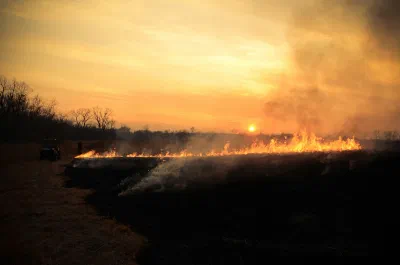
A controlled burn—foresters say prescribed burn, which I find a cold way to say it—is a fire that people light on purpose, in a place they have chosen, on a day they have chosen, and then stay and watch until it is out.
That is the whole of it. The difference between a controlled burn and a wildfire is not the flame. It is the planning.
A wildfire arrives when the woods are dry as tinder and the wind is up and no one is prepared. A controlled burn is lit when the ground is damp beneath, the wind is soft, the humidity is right, and there are people standing at the edges with tools in their hands. Same fire. Entirely different animal.
Why My Grove Is Dying Without Fire
I want to start here, because this is the part that changed my mind, and it took forty years to change.
You may know my mother as Grandmother Oak. Her tree is a Welsh oak, but she planted her acorn in a stand of Oregon white oak—Garry oak, most people here call it—and those oaks are the reason this grove exists at all.
Those oak prairies are not wild. They never were. The oak savanna that once ran across this region was made and kept by people, by regular, deliberate, low burning, for thousands of years. When the burning stopped in the mid-1800s, the Douglas-fir came. Fir grows fast and tall and it shades out oak, and oak cannot live in shade. It simply gives up.
About five percent of Washington’s original oak prairie is left.1
Five percent. I watched most of that happen. I arrived here with my mother in 1883 and I have stood in this clearing while the firs closed over it like a hand, and for the whole of that time I told myself that at least nothing was burning.
I was wrong. Something was dying. It was just doing it slowly enough that I could pretend I was not watching.
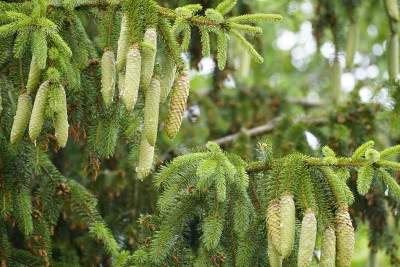
The fir is not the villain either. It is simply doing what it does when nothing stops it. // Image credit beauty_of_nature from Pixabay
My Own Tree Needs This
I bonded to a Western Larch when I came to Washington. I have never regretted it. Larch is the finest tree on this coast and I will argue that with anyone.
Larch is also the most fire-resistant tree in this part of the world.2 Her bark is corky and enormously thick—five to ten inches at the base by the age of fifty, up to eighteen inches by a hundred years—and it protects the living tissue underneath from heat. She drops her lower branches as she grows, so flame has no ladder to climb. She is deciduous, unusual for a conifer, so losing her needles does not frighten her the way it would frighten a fir.
She is built for fire. She was always built for fire.
And here is the sentence I have been circling for four decades. Without fire, western larch does not regenerate. It gets replaced by shade-tolerant species that grow up underneath it, and in time it is gone from the stand entirely.2
The tree I love needs the thing I fear. I have had a long while to make peace with that and I have not managed it. I have only managed to stop letting it decide what I do.
Some Trees Will Not Even Open Without It
There are trees whose seeds are sealed shut with resin and will not open until fire melts them. Foresters call these cones serotinous. Lodgepole pine does this. So does the giant sequoia, the largest living thing on this earth.3
Those seeds then land on bare, ash-fed ground with the competition burned back and the light coming through.
The sequoia does not survive fire. The sequoia requires it.
The People Who Knew This First
None of this is a discovery. It is a re-remembering, and it should be said plainly whose knowledge is being remembered.
Across this region, Coast Salish people cultivated camas in tended, marked fields and burned them on a regular cycle—small burns, an acre or two at a time, coming back to the same ground every few years to hold back the grasses and shrubs.4 More than two million acres of prairie and oak woodland were maintained that way.
By the time my mother and I reached Snohomish in 1883, that burning was already being taken from the people who did it. In California, cultural burning was effectively outlawed for more than a century and a half. The Karuk and Yurok Tribes have been bringing it back—burning to restore hazel for basketweaving, and to bring back the food plants that come with good fire—and California has only recently begun clearing the bureaucratic obstacles out of their way.5
Two hundred years of dryad memory, and the correct answer was being practiced here before I arrived, by people who were then forbidden to practice it.
How It Is Done Now
The humans have gotten better at this than I expected, as little as I am pleased to admit it.
- The unit. They mark exactly what will burn and use roads, streams, or hand-cleared line as the boundary.
- The weather. They wait. This is most of the job. Wrong wind or wrong humidity and everyone goes home and tries again next week.
- The ignition. On the ground they use a drip torch—a canister that dribbles burning fuel in a line. From the air, small spheres of potassium permanganate are injected with glycol as they drop, which sets off a reaction that ignites them twenty to forty seconds later, on the ground, where they were aimed.6
- The watch. Nobody leaves. They stay with it until it is cold.
What It Costs, Honestly
I will not sell you this.
The Forest Service lights around 4,500 controlled burns a year across roughly 1.3 million acres. Their own review found that 99.84 percent go according to plan.7
That leaves about seven a year that do not.
In 2022, an escaped prescribed burn in New Mexico became the Hermit’s Peak/Calf Canyon Fire, the largest wildfire in that state’s recorded history. Homes were lost. Ground was lost. Whatever a grove is to those trees, it was lost.
I am not going to stand here and tell you that number is small, because I know exactly what one of those seven feels like from underneath. Seven is not small when you are one of them.
What I will tell you is the other side of the ledger, which nobody puts on a poster. The fires that come when nobody burns anything on purpose do not come at 99.84 percent success. They come in August, in the wind, into fuel that has been piling up for a hundred years, and they do not stop where anyone decided they would.
I have counted the dead on both sides. The arithmetic is not close.
Where It Does Not Belong
Fire is not medicine everywhere. Rainforest is not built for it. Alpine meadow, where a plant may take a century to come back, is not built for it. Some desert systems have been so overrun with invasive grasses that fire now feeds the invader instead of the native ground.
A tool is not a virtue. Fire belongs where fire has always been. Elsewhere it is simply destruction with paperwork attached.
What I Actually Want You to Do
You are young and most of you will not be lighting anything.
- When a burn is announced near you and the neighbors start complaining about the smoke, be the one who knows what it is for.
- Learn whose land you are standing on and whether they burned it. They probably did.
- If you are going into the woods, understand that a stand of forest with a burn scar on it is a healthier stand, not a ruined one.
- Do not confuse a fire someone chose with a fire that chose you.
I have spent two centuries as the wrong dryad to write this. I am the one who wakes at the smell of smoke. I am the one who will not have an open flame in this clearing.
I am also the one responsible for every tree here, and that responsibility does not care what I am afraid of.
Plant life first. Even when it burns.
Klifal, Dear reader and Tsitwash for Reading!
Note: Klifal and Tsitwash are words in Dryadic. Klifal means “Hello” and Tsitwash means “Thanks.”
I hope you enjoyed this article! If you liked my unique perspective, you’ll love reading my full story in the novel Digital Dryad by Jennifer Kyrnin. Digital Dryad is available where all books are sold, in print and ebook formats.
Want more tales straight from the dryad’s mouth? Sign up for my newsletter to receive exclusive short stories, behind-the-scenes looks at Digital Dryad, and advance notice of new book releases in the series.
You can also connect with me and other fans of Digital Dryad on Mastodon. Jennifer is active on Mastodon under the handle @htmljenn. Share your thoughts using the hashtag #digitalDryad!
Thank you for joining me on this journey! With your support, I can continue telling my story. I hope to see you again between the pages and in the newsletter!
Sincerely, Sierra
Stay in TouchOregon white oak woodland extent and Douglas-fir encroachment following the end of the pre-settlement burning regime — Resilience of Oregon white oak to reintroduction of fire, Fire Ecology; Continued response of Oregon oak to release treatments, US Forest Service ↩︎
Bark thickness, self-pruning, deciduous habit, and seral status — Western Larch, Native Plants PNW; Fire Resistance and Regeneration Characteristics, US Forest Service ↩︎ ↩︎
Coast Salish Camas Cultivation, HistoryLink; Fire and the Coast Salish Three Sisters, Nonprofit Quarterly ↩︎
Revitalized Karuk and Yurok cultural burning, Fire Ecology; California can right a historic wrong, CalMatters ↩︎
Igniting the future — technology on prescribed fire, US Forest Service ↩︎
National Prescribed Fire Program Review, USDA Forest Service, 2022 ↩︎