The Forest Survived the Drought—the Next Forest Didn't
The canopy and carbon held. The fruit didn't, and in the Andes that loss reaches 16 million people downstream.
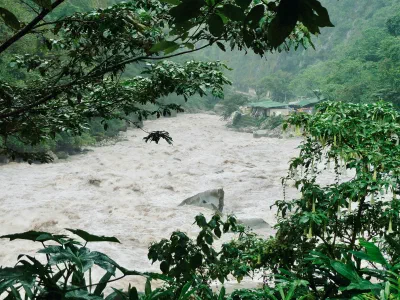
For five years, researchers prevented the rain from reaching part of a cloud forest in the Peruvian Andes. Soil moisture dropped by 69%. If that happened in my forest I’d expect the trees to brown, drop their leaves and start falling over. The studied trees didn’t. The canopy held, and so did the carbon numbers. By most measures a forester would check from the trail, the stand came through severe drought looking fine. But it had almost stopped making fruit. Fruit production fell by 90.6%. The forest survived the drought but stopped making the next forest.
What Is a Cloud Forest?
Most Westerners picture a forest like the ones you might find in my beloved Pacific Northwest Dryad grove or in other temperate zones of the world—a mix of deciduous and coniferous trees supporting a mix of plant and animal species.
A cloud forest is a rare type of tropical or subtropical rainforest that has persistent low-level cloud cover at the canopy. This constant cloud cover allows the forest to capture moisture directly from the air. The trees’ canopy traps the moisture or funnels it down to the cooler understory and ground below them. Trees in cloud forests provide sources of freshwater through fog drip, feeding the streams below and supplementing the rain.
Scientists did a five-year experiment on a section of Peruvian cloud forest.1 They simulated drought conditions, reducing soil moisture by almost 70%. They then compared that plot of forest with a control plot without the drought conditions.
They found that the trees were able to survive and in fact showed no net change in the amount of carbon uptake in the ecosystem. The trees grew denser wood and had more starch in them.
But the trees produced significantly less fruit.
In other words, the individual trees survived the drought, but they did not produce enough offspring to maintain the forest as a whole, into the future.
But It Gets Worse
Research published in the Journal for Nature Conservation used machine learning to make a prediction of how the distribution of cloud forests in South America might change. They looked at a high-emissions pathway and a more optimistic scenario.
Under the high-emissions conditions, they estimated that as much as 91% of the area where cloud forests can grow could be lost. Unfortunately, even under the most optimistic scenario, the researchers calculated a 12% reduction. That’s roughly 8,000 square miles or the size of El Salvador.2
Why Does It Matter?
With the loss of the cloud forests, we lose so much more than just trees. We lose the varied plants and animals that rely on those forests to survive. Some species only live in cloud forests and if their habitat is gone, so are they.
But the cloud forests do more than protect plants and animals. They also provide fresh water to nearly 16 million people. The real impact of the loss of these forests is the loss of that fresh water capture. These trees capture the water in the fog and it drips down to the soil below and fills the local rivers which all living beings on Earth need to survive.
So the next time you’re hiking in your favorite forest, consider this: a forest might look healthy to you, but be hiding a serious problem that can’t be seen from the ground.
Klifal, Dear reader and Tsitwash for Reading!
Note: Klifal and Tsitwash are words in Dryadic. Klifal means “Hello” and Tsitwash means “Thanks.”
I hope you enjoyed this article! If you liked my unique perspective, you’ll love reading my full story in the novel Digital Dryad by Jennifer Kyrnin. Digital Dryad is available where all books are sold, in print and ebook formats.
Want more tales straight from the dryad’s mouth? Sign up for my newsletter to receive exclusive short stories, behind-the-scenes looks at Digital Dryad, and advance notice of new book releases in the series.
You can also connect with me and other fans of Digital Dryad on Mastodon. Jennifer is active on Mastodon under the handle @htmljenn. Share your thoughts using the hashtag #digitalDryad!
Thank you for joining me on this journey! With your support, I can continue telling my story. I hope to see you again between the pages and in the newsletter!
Sincerely, Sierra
Stay in TouchBartholomew et al., Global Change Biology, 2026 https://onlinelibrary.wiley.com/doi/10.1111/gcb.70670 accessed: 2026-10-07 ↩︎
Liz Kimbrough, Climate change could erase most South American cloud forests, study warns. Reported by Mongabay https://news.mongabay.com/2026/05/climate-change-could-erase-most-south-american-cloud-forests-study-warns/ accessed: 2026-10-07 ↩︎