Trees leave space for each other
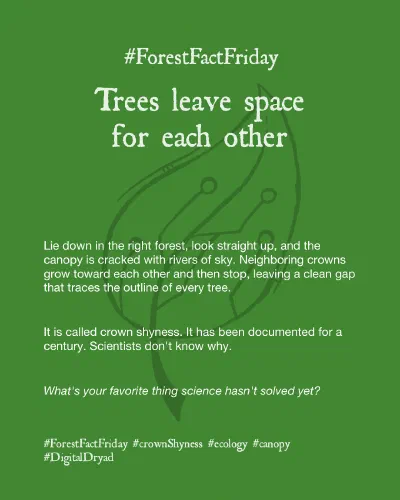
Lie down in the right forest, look straight up, and the canopy is cracked with rivers of sky. Neighboring crowns grow toward each other and then stop, leaving a clean gap that traces the outline of every tree.
It is called crown shyness. It has been documented for a century.
Wind knocking the branch tips against each other, trees sensing their neighbor’s shade, keeping disease from jumping the gap—all plausible, none settled. It is one of the most photographed things in any forest and we still cannot say why it happens.
Trees don’t solve this one problem at a time. In a study that came out in September 2026, Michigan morning glories adapted for bigger flowers to catch the scarce pollinators. Because of this, they don’t flower as early in the Spring, which is what they need to do to as the temperature rises. Scientists found that they are adapting about eight times slower than they should be to survive climate change. And it’s not that they can’t adapt. They are, but to fix the wrong thing.
What’s your favorite thing science hasn’t figured out yet?
Sources
- Crown shyness—are trees social distancing too? — Natural History Museum
- Understanding crown shyness from a 3-D perspective — Annals of Botany 2021
- Plants may be evolving the wrong traits for a warming world — Science Daily, Sept 3, 2026
Sources checked 2026-09-05.